Cable in the
Crossfire
Sterling is staging a quiet comeback. But between a hawkish Bank of England, a fragile Iran ceasefire, and a US dollar losing its grip — the pound's rally looks anything but simple.
There's a reason traders still call it "Cable." The nickname dates back to the 19th century, when GBP/USD rates were transmitted via a transatlantic telegraph cable stretched beneath the Atlantic Ocean. It connected two worlds, two economies, two ambitions. In April 2026, that cable feels more electrically charged than ever — stretched taut between a cautiously resurgent pound and a dollar wrestling with its own identity crisis.
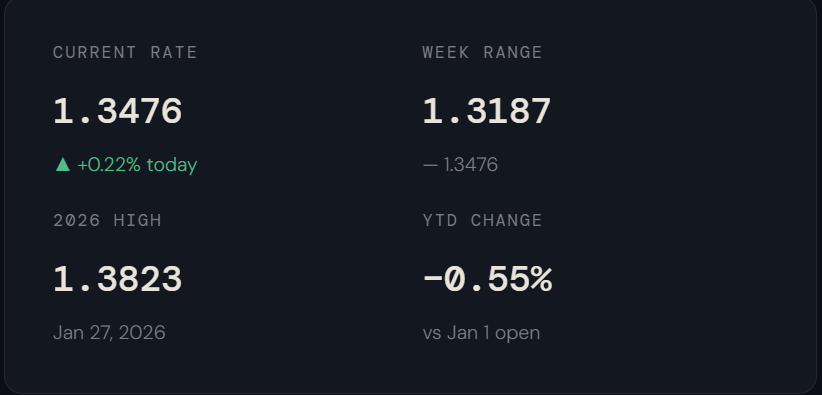
As of Friday, 11 April, sterling is trading just above the $1.34 handle — a level it has been clawing back toward for weeks. It's the pair's strongest showing since late February, and it arrives with a near 1.5% weekly gain tucked under its belt. That's not a number the market is ignoring.
The Dollar's Wobble
Let's start where the story really begins: Washington. The US dollar has had a disorienting few months. Tariff escalations, mixed Fed signals, and a White House that keeps pivot-hinting without ever fully committing have kept dollar bulls perpetually off balance. Markets had once priced in multiple Fed rate cuts through 2026, but sticky inflation data trimmed that enthusiasm considerably. Now, with oil prices edging up amid Middle East disruptions, inflation fears are circling back.
The result? A dollar that doesn't quite know whether to strengthen on safe-haven flows or weaken on policy uncertainty. That ambiguity has been sterling's gift — and Cable has taken it with both hands.
"A currency pair rarely moves in isolation. GBP/USD in 2026 is as much a story about the dollar's identity crisis as it is about Britain finding its footing."
— Senior FX Desk Note, April 2026
Sterling's Quiet Confidence
The pound's resurgence has been notable for its composure. Unlike some of the sharp, headline-driven spikes we saw during the 2022–2023 Gilt crisis era, this rally has been built on something more durable: a repricing of Bank of England (BoE) rate expectations.
Rising oil prices — themselves a byproduct of Iran's ongoing Strait of Hormuz blockade — are reigniting UK inflation fears. The Hormuz situation has been described by some energy analysts as the worst supply disruption in history. That might be overstating it, but it isn't far off. Energy shocks have a nasty habit of passing through into CPI numbers, and the BoE knows this. Markets are now pricing in at least one BoE rate hike before year-end — a significant hawkish shift that has provided sterling with solid fundamental support.
For currency traders, a hawkish BoE is broadly bullish for GBP. Higher rates attract capital inflows, improve the yield differential against the dollar, and signal policy credibility. All three dynamics are in play right now.
Geopolitics: The Wild Card That Never Leaves
No GBP/USD analysis this month would be honest without confronting the geopolitical elephant in the room — or rather, the tanker in the strait. Iran's blockade of the Strait of Hormuz has sent shockwaves through energy markets. Approximately 20% of global oil flows through that corridor, and Tehran has made clear it's not moving without concessions. That disruption is pushing Brent crude higher, complicating monetary policy on both sides of the Atlantic.
Meanwhile, Ukraine's lead negotiator hinting at progress in Russia peace talks injected a brief dose of risk-on optimism into markets last week. When geopolitical risk recedes, investors tend to rotate out of safe-haven dollars and into higher-yielding, growth-sensitive currencies — and sterling often benefits in that rotation.
The calculus, though, is fragile. Israel's latest military strikes on Lebanon have widened the regional flashpoint, and Iranian threats of retaliation could reverse that risk sentiment in hours. For cable traders, the geopolitical premium in the dollar is both a competitor and a crutch — remove it and the pound can run; add it back and GBP/USD quickly finds headwinds.
Where Does Cable Go From Here?
Consensus among strategists leans cautiously constructive on GBP/USD through Q2 2026, with a general expectation that the pair can reclaim the 1.36–1.38 corridor if the macro narrative holds. That, however, is a substantial "if."
The key resistance to watch is the January high of 1.3823 — a level that capped the pair's most bullish stretch of the year. Getting there would require dollar weakness to persist, BoE hawkishness to be sustained, and geopolitical tensions to not take a decisive turn for the worse. That's three conditions simultaneously, which is never a comfortable trade setup.
On the downside, the March low of 1.3182 remains the bear case anchor. A breakdown there — perhaps triggered by a re-escalation in the Middle East or a surprisingly hawkish Fed statement — would put 1.30 psychological support back in scope. That's a scenario traders can't entirely dismiss, given how quickly sentiment has shifted in this pair over the past six weeks.
The Bottom Line
GBP/USD is, at its core, a pair defined by complexity. It's never been a clean trade — not in the post-Brexit years, not during the Truss market shock, and certainly not now, when the backdrop involves a Middle Eastern energy crisis, a tentative European peace process, and two central banks trying to read inflation signals in real time.
What we can say with confidence: Sterling has found better fundamental footing than it's had at any point in the past 12 months. The BoE's hawkish tilt is real, dollar headwinds are meaningful, and the pair is trading with a quiet dignity that suggests the 1.3187 low of last week may mark a significant short-term floor. But anyone calling the cable a one-way trade right now hasn't been paying attention.
The transatlantic cable still crackles. And for traders positioned on either side of this pair, April 2026 is shaping up to be one of those months where patience and precision will matter more than bold conviction. Watch the 1.35 handle. Watch BoE communications. And keep one eye on Tehran.
Disclaimer: This article is for informational and educational purposes only and does not constitute financial advice, investment recommendations, or an inducement to trade. All exchange rate data is sourced from publicly available market data providers. Past performance of currency pairs is not indicative of future results. Trading foreign exchange carries significant risk of loss. Always consult a qualified financial advisor before making any investment decisions.