EUR/USD: THE WORLD'S MOST-TRADED CURRENCY PAIR
The euro and the dollar are navigating a world reshaped by divergent monetary policy, tariff shocks, and a changing reserve landscape, from parity concerns to four-year highs.

What is EUR/USD?
EUR/USD is the exchange rate between the Euro — the shared currency of nineteen European Union member states — and the US Dollar, the world's dominant reserve currency. It tells you how many US dollars one Euro buys. If EUR/USD reads 1.1639, a single Euro is worth $1.1639.
As the most heavily traded currency pair in the world, EUR/USD accounts for roughly 24% of all global foreign exchange volume, dwarfing other pairs. It is the benchmark by which currency market conditions are judged, and its movements impact equity, commodities, and bond markets worldwide.
"The Euro constitutes 57.6% of the DXY basket — it is difficult for the dollar to trend meaningfully without the Euro moving in the opposite direction."
— Forex.com Senior Strategist, January 2026
The 2025 narrative: from parity concerns to multi-year highs
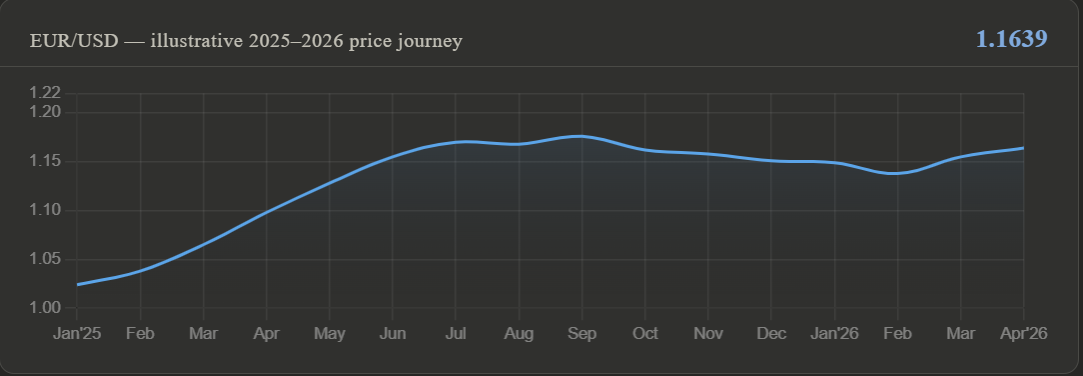
At the beginning of 2025, consensus expected EUR/USD to test parity — that psychologically charged 1.00 level where one Euro buys exactly one Dollar. The pair had fallen sharply in late 2024, and markets were braced for further dollar strength driven by US uniqueness and tight Fed policy.
It never happened. EUR/USD set its yearly low in early January 2025 near 1.02, and then spent the next several months staging a dramatic reversal. The pair had surged over 17% from those lows, exhausting near 1.1700 — a level last seen years earlier. The US dollar suffered its worst first half in fifty years, with the DXY falling about 10.7% in H1 2025 alone.
The drivers were a strong mix of worries about the US economy, uncertainty caused by tariffs, a waning faith in the dollar's safe-haven appeal, and a growing belief that the Federal Reserve would need to ease more than the markets had priced in. The second half of 2025 saw consolidation, with EUR/USD trading in a wide band between roughly 1.1500 and 1.1823.
Key drivers shaping the pair
EUR/USD is driven by the meeting point of two economic superpowers. Understanding what moves the needle requires watching several interrelated forces:
📈Bullish for EUR Fed rate cuts widening policy gap vs ECB Weak US fiscal outlook & dollar sell-off Central banks diversifying into euros Eurozone growth improving in 2026 Foreign inflows into European bonds/equities
📉Bearish for EUR Stronger-than-expected US jobs data Fed staying neutral / pausing cuts USD Treasury yield rebound Risk-off sentiment lifting the dollar Eurozone growth disappointments
Monetary policy divergence: the central theme
The dominant narrative heading into 2026 is monetary policy divergence. The Federal Reserve cut rates three times in 2025 and closing the year with benchmark rates at 3.50%–3.75%. Markets are pricing more cuts in 2026, with a high probability the Fed eases at least twice more — perhaps three times if labor market data becomes softer.
The European Central Bank, meanwhile, left rates unchanged in December 2025. ECB President Christine Lagarde flagged domestic demand and government infrastructure and defense spending as the main growth engines. With Eurozone inflation projected to remain near its 2% target through 2028, the ECB appears comfortable holding steady through 2026. This policy gap — a cutting Fed versus a patient ECB — creates a structural tailwind for the Euro relative to the Dollar.
"With the ECB on hold and the Fed expected to ease further, the interest rate disparity is likely to be supportive for the Euro throughout the year ahead."
— Forex.com 2026 EUR/USD Outlook, December 2025
What the major banks are forecasting
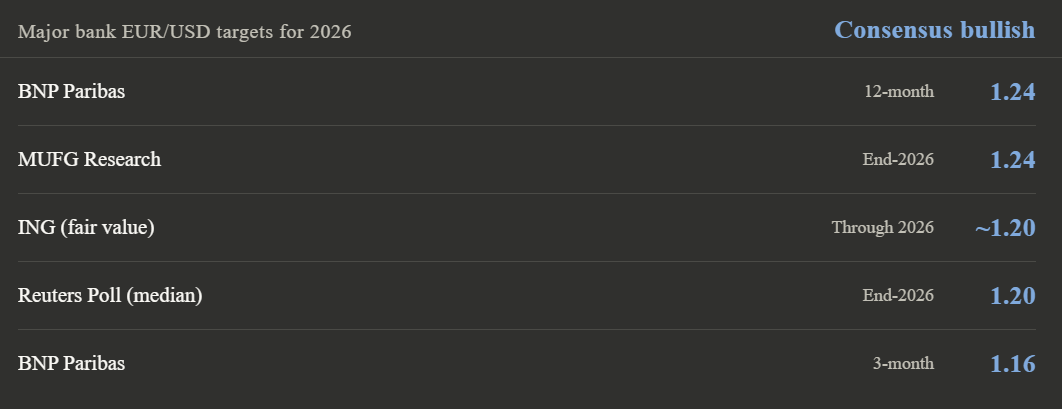
A Reuters poll of currency strategists from late 2025 painted a picture of broad, if cautious, euro optimism. The median expectation placed EUR/USD near 1.17 in three months, rising toward 1.20 by year-end 2026. Individual institutional views vary, but the direction is consistent:
Technical picture: the range that defines the market
From a technical perspective, EUR/USD has been locked in a wide consolidation range since mid-2025, capped at roughly 1.1823 at the top and supported near 1.1509 at the bottom. Neither bulls nor bears have managed a sustained breakout from this structure.
The RSI has been trading below the neutral 50 mark in recent weeks, suggesting short-term bearish momentum. The MACD histogram is also below zero, reinforcing the possibility of near-term selling pressure. The pair currently sits below its 50-day and 200-day simple moving averages, both near 1.17. A sustained break above 1.18 would be technically significant and could activate a broader bullish trend; a break below 1.15 would tilt the bias decidedly lower.
The broader dollar question
The dollar's long-term trajectory is perhaps the most debated topic in global macro. The DXY fell roughly 9% in 2025, one of its sharpest annual declines on record. MUFG expects a further 5% decline in 2026, while central banks globally are showing a renewed appetite for diversifying reserves into euros — a structural shift accelerated by concerns over US debt dynamics and fiscal policy.
The OMFIF Global Public Investor 2025 Survey revealed growing plans among global reserve managers to increase euro holdings. If this reallocation gathers pace, it could provide a persistent, low-volatility bid for the euro that underpins the pair well above prior equilibrium levels. That said, any surprise strength in the US economy — particularly a hot jobs print or a resurgence of inflation — could swiftly restore dollar confidence and reverse recent gains.
How to read EUR/USD as a trader or traveller
If you are travelling from the Eurozone to the United States, a higher EUR/USD is good news — your euros buy more dollars. At 1.16, every €1,000 nets you $1,160. If the rate were back at parity (1.00), you would only get $1,000.
For traders and investors, EUR/USD movements have wide implications. A rising Euro can weigh on European exporters (their goods become more expensive abroad) while benefiting US importers of European goods. It can also reflect risk sentiment: the dollar tends to strengthen during global stress events as investors seek safety, while the Euro often gains when confidence in global growth improves.
Disclaimer: This blog post is for informational and educational purposes only. It does not constitute investment, financial, or trading advice. Forex trading involves significant risk of loss and is not suitable for all investors. Always seek independent professional advice before making any financial decision. Exchange rates referenced reflect data available as of April 2026.